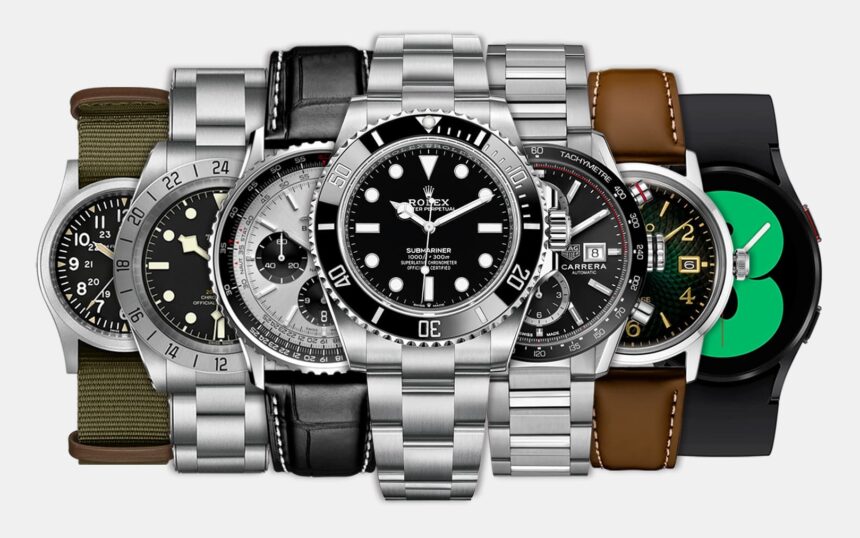
Most watch enthusiasts own multiple pieces before they ever ask themselves a genuinely uncomfortable question: do I have a collection, or just a pile of watches?
The distinction matters more than it might seem. A curated collection holds its value, tells a coherent story, and becomes more meaningful over time. A random assortment tends to stagnate, overlap in function, and ultimately frustrate the person who built it. Understanding the difference is the first step toward collecting with real intention.
Brands like Rolex, Audemars Piguet, and Richard Mille recur in serious collections because their catalogues offer genuine depth. A collector can spend years exploring a single brand and still find meaningful distinctions between references, production years, and variants.
What Makes Something a Collection
A collection is not defined by quantity. Owning twelve watches does not make you a collector any more than owning twelve books makes you a scholar. What defines a collection is coherence: a thread, however subtle, that connects the pieces and gives the whole more meaning than any individual item could carry alone.
That thread can take several forms:
- A maker or maison focusing on a single brand across different references or eras
- A complication building around a specific technical achievement, like perpetual calendars or minute repeaters
- An era covering vintage pieces from a particular decade, unified by design language and manufacturing context
- A philosophy rooted in independent watchmaking, haute horlogerie, or tool watches designed for professional environments
None of these frameworks is more legitimate than another. What matters is that the framework exists at all.
How a Random Assortment Develops
Random assortments rarely form through carelessness. They typically develop through enthusiasm without strategy, which is an easy trap to fall into.
A buyer picks up a steel sports watch because it seems versatile. Then they find a dress watch at a good price and can’t resist. A limited edition from a brand they admire goes up for sale. A friend recommends something they’d never considered. Before long, there are six watches occupying six very different worlds, with no meaningful relationship between them.
This is not a failure of taste. It’s a failure of framework. The individual decisions often made sense in isolation. The problem is that collecting in isolation doesn’t compound the way intentional collecting does.
Hospitality professionals who work with high-net-worth clients often describe the same pattern with art: buyers accumulate impressive individual pieces, then reach a point where they can’t hang everything without the room looking chaotic. Watches work the same way, just with a watch box instead of a gallery wall.
The Hidden Cost of an Incoherent Collection
There are practical consequences beyond aesthetics. An incoherent assortment creates functional redundancy and financial inefficiency.
If four of your six watches are casual steel sports watches with date complications, you’re over-invested in a single use case and likely under-served everywhere else. You might own expensive watches that never get worn because they don’t fit any occasion in your actual life. Worse, the pieces that do overlap in function often compete against each other for wrist time, meaning one or more will sit in the box for months at a stretch.
From a value perspective, a focused collection in a recognised category tends to appreciate more predictably. Collectors and dealers understand what you’ve built and why. A random assortment is harder to appraise, harder to sell selectively, and harder to build on because you’re not sure what direction you’re building in.
What Intentional Collecting Actually Looks Like
The most admired private collections tend to share a few observable traits regardless of budget.
Each Piece Has a Reason to Exist
A well-curated collection contains no accidental purchases. Every watch fills a specific role: a daily wearer, a formal piece, a technical showpiece, a vintage anchor. When you can articulate why each watch is in the collection, you probably have a collection. When you can’t, you probably have an assortment.
There Are Deliberate Gaps and Deliberate Choices
Intentional collectors say no as often as they say yes. They recognise that buying everything interesting is not collecting, it’s a form of hoarding. The best collections have clear boundaries, and the collector knows when something falls outside them.
This is especially relevant when access opens up for highly sought-after references. Knowing whether a given piece fits before you pursue it saves both money and regret.
The Anchors Are Strong
Every serious collection has one or two anchor pieces: the watches that define the collection’s identity and against which everything else is measured. For many collectors, those anchors come from a short list of makers with the depth to support long-term focus.
That depth is what makes a brand capable of anchoring a collection rather than just contributing to an assortment.
For collectors building seriously in this space, access matters as much as intention. The pre-owned market is where the most deliberate collecting happens, particularly for references on allocation or discontinued references with historical weight. Working with an established dealer like Wrist Aficionado gives collectors both verified authenticity and access to a rotating inventory that supports deliberate decision-making rather than reactive buying.
Access to an authentic Patek Philippe collection, for example, allows you to compare references, conditions, and vintages side by side, which is exactly what separates intentional collecting from impulse buying.
Building Around Patek Philippe as a Case Study
Patek Philippe is worth examining specifically because it illustrates how an anchor brand functions at its best.
The maison produces watches across an enormous range of complications, price points within luxury, and design philosophies. A collector focused on Patek could build coherently around dress watches, around complications like the annual calendar, around specific references across decades, or around the nautical-influenced Aquanaut and Nautilus lines.
Each of those sub-focuses is a collection in its own right. A buyer who picks up a Calatrava because it seemed like a safe investment, and then adds a complications piece because the price was right, does not have a Patek collection. They have two expensive Patek watches and no particular direction.
The same logic applies across other major houses. A collector building around Audemars Piguet has the Royal Oak lineage, limited editions, and complications to navigate with genuine depth. Rolex offers similar breadth across its professional and dress references. Richard Mille attracts collectors drawn to technical innovation and material experimentation as their organising principle. In each case, the brand works as an anchor because it offers enough internal variation to build a coherent collection within it, rather than requiring the collector to range across multiple houses without direction.
Practical Steps Toward a More Intentional Collection
Transforming an assortment into a collection doesn’t require selling everything and starting over. It requires clarity first, then action.
Audit what you have. Lay out everything you own and write one sentence about why each piece is there. If you can’t write that sentence, the watch probably doesn’t belong.
Identify your actual framework. Not the framework you think sounds impressive, but the one that genuinely reflects your taste, lifestyle, and long-term interest. Be honest about this. A collection built around a framework you don’t care about will feel hollow in five years.
Define your anchors. Pick the one or two pieces that you would never sell, and work outward from there. Every new acquisition should have a clear relationship to those anchors.
Set criteria before you buy. Before any purchase, run it through a simple checklist: Does this fit my framework? Does it fill a role nothing else fills? Can I clearly articulate why this piece belongs? If the answers are uncertain, wait.
Use trusted sources for access. Pre-owned markets are where the most interesting collecting happens, particularly for references on allocation or discontinued references with historical weight. Working with established dealers gives collectors both verified authenticity and access to a rotating inventory that supports deliberate searching rather than impulse buying.
Why the Best Collections Keep Getting Better
A well-built collection has a compounding quality. Each new addition strengthens the whole because it was chosen to fit. The collection becomes easier to read, easier to talk about, and more interesting to the people who understand what you’ve done.
Authority sources in the watch world, including publications like A Blog to Watch and reference databases used by serious dealers, frequently note that the most valuable private collections are almost always highly focused ones. Breadth without depth rarely commands the same attention, financial or otherwise.
There’s also a personal dimension that matters. A curated collection represents genuine decision-making, restraint, and knowledge. It reflects the collector’s perspective rather than just their ability to buy things. That difference is visible to anyone who knows watches well.
Key Takeaways
- A collection is defined by coherence and intention, not by how many pieces it contains
- Random assortments usually form from good individual decisions made without an overarching framework
- Functional redundancy and unclear direction are the practical costs of collecting without strategy
- Every serious collection benefits from one or two strong anchor brands with genuine catalogue depth
- Deliberate collecting means saying no as often as yes, and having clear criteria before any purchase
Frequently Asked Questions
How many watches do you need before it becomes a collection? Number is irrelevant. A single carefully chosen watch paired with a clear intention about where the collection is going is more meaningful than fifteen watches acquired without direction. The framework matters, not the headcount.
Is it too late to turn an assortment into a collection? Not at all. Most serious collectors have an assortment phase they look back on with mild regret. The transition usually begins by identifying which pieces genuinely reflect your taste and building the framework around those rather than treating everything as equal.
Should I sell watches that don’t fit my collection framework? Generally, yes. Watches you don’t wear and that don’t serve a strategic purpose in your collection are capital tied up in regret. Releasing them funds the pieces that actually fit. The exception is anything with genuine sentimental value, which operates by different rules entirely.
Does a curated collection have to focus on expensive watches? Absolutely not. Some of the most respected collections are built around a single brand at accessible price points, or around vintage pieces that required knowledge rather than capital to identify. Budget is a constraint, not a proxy for quality of collecting.
How do I know when a piece is genuinely right for my collection versus just desirable in the moment? The simplest test: wait seventy-two hours after deciding you want something, then ask whether your reasoning is still the same. If the case for buying depends on availability pressure or an emotional high, it usually isn’t the right piece for a considered collection.
Conclusion
The gap between owning watches and building a collection is not about money or access. It’s about the clarity of thought you bring to each decision. A random assortment can contain extraordinary individual pieces and still feel unsatisfying. A focused collection built around genuine taste and deliberate criteria becomes more valuable, more coherent, and more personally meaningful over time.
The next time a watch catches your attention, the most useful question isn’t whether you can afford it. It’s whether it belongs.