Accidents in the workplace are not just random occurrences but rather the outcome of the lack of recognition of dangers and the absence of control of risks. As a result of their inability to prevent accidents by recognizing them, companies suffer every year with operational interruptions, legal issues and, most significantly, unavoidable injuries.
Good health and safety management practices are not about reacting to incidents after they have taken place. It is about establishing systems for the recognition of the dangers that are going to cause trouble in the first place. That is exactly what Hazard Identification and Risk Assessment is for.
What Makes HIRA Essential for Workplace Safety?
HIRA is first among equals in the safety program. It is the method that enables the company to take advantage of safety’s drawing board and make the area of worker protection the top priority in terms of the risks that are present and the procedures for handling them.
Consider HIRA to be your safety radar. While you can easily spot risks such as unguarded machines or spilled chemicals, HIRA will help you detect the less visible threats like ergonomics problems that arise over a time period, monotonous work that results in long-term injuries and environmental conditions that gradually weaken worker’s health.
The procedure consists of the splitting up into two crucial parts. The first one is the hazard identification which scrutinizes your entire workplace in search of anything that could potentially cause harm. The second part is the risk assessment that estimates the likelihood of the injury caused by that hazard and how severe that injury might be.
Bingo! You have a full view of the situation and you can now direct your efforts towards the areas that need it most.
Why Traditional Safety Measures Fall Short
However, many organizations continue to rely on very basic safety measures, such as hard hats, safety signs and annual training sessions. They are the measures that matter but are reactive rather than proactive.
The traditional methods usually fail because they apply the same treatment to all the risks. A non-fatal slip hazard is treated with the same concern that a life-threatening and detrimental failure of a machine would receive. If there is no risk assessment then you are just guessing where to put the safety resources and you can waste your resources.
Besides, the workplace is a dynamic environment, always undergoing change. New machines, new techniques and new materials come into your factory area. Static safety provisions cannot cope with these changes and thus, create gaps where accidents can slip through.
How HIRA Transforms Your Safety Culture
The integration of health and safety management through HIRA signifies a revolutionary change in the perception of safety within your organization.
Rather than being alert for an accident to disclose an inadequacy in the system, you are constantly looking for hazards. The safety-conscious approach gets adopted in every operation, every machine and every place in the factory. The spirit of prevention becomes a part of your company culture.
The employees turn into safety partners instead of being the non-active followers of safety regulations. When workers are engaged in the process of hazard identification and risk assessment, they are far more likely to report potential problems and to make suggestions for improvements.
The shift in the organization’s culture leads to a natural decrease in accidents. People start to recognize the issues sooner and that too, before they develop into crises.
Understanding Risk Assessment Fundamentals
When the hazards are recognized, the implication of understanding HIRA is carrying out a proper evaluation of each one of them through a systematic approach of risk assessment.
The risk assessment measures two important aspects- likelihood and severity. What is the probability that the hazard will give rise to an accident? In case an accident happens, what will the consequences be in terms of seriousness?
A hazard might be unlikely but with a severe consequence, like a chemical explosion. On the other hand, there might be one that is very probable but the penetration would only be through minor cuts from packaging. Both need attention, but your response will differ based on this assessment.
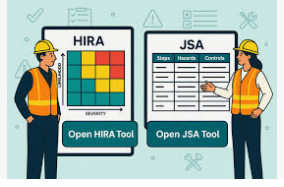
Use a risk matrix to categorize hazards. This visual tool helps you plot each risk according to its likelihood and severity, creating clear priorities for your safety interventions. High-likelihood, high-severity risks demand immediate action. Lower-risk items can be addressed through routine safety improvements.
Document everything. Your risk assessments should create a clear record of identified hazards, their evaluated risk levels and the rationale behind each assessment. This documentation protects your organization legally and provides a baseline for measuring safety improvements.
Making HIRA Part of Your Daily Operations
HIRA should not be a once-a-year activity. Proper health and safety management practices integrate hazard identification and risk assessment into routine operations.
Carry out HIRA assessments whenever you plan to purchase new equipment, change processes, or make alterations in work areas. These actions create new hazards or change the risk profiles of the hazards that already exist. To keep pace with the situation, you need to do continuous assessments.
Establish regular review cycles for different areas of your operation. High-risk areas might need monthly reviews, while lower-risk zones could follow quarterly or semi-annual schedules.
Create feedback loops where workers can report new hazards or changing conditions. Make reporting simple and ensure every report receives follow-up. This keeps your HIRA current and demonstrates that safety concerns matter.
Track leading indicators, not just lagging ones. Instead of only counting injuries after they happen, monitor how many hazards you identify, how quickly you address risks and how many near-misses your system catches. These metrics show your safety management system working before incidents occur.
Training Your Team for HIRA Success
The effectiveness of your HIRA process is entirely dependent on people’s comprehension and application of it. Training comprehensively transforms your safety strategies from theory to real-life application.
Start with the top management. The leaders have to be very well versed in HIRA so as to be able to resource the right way and to support the safety initiatives. Once the managers give priority to the hazard identification and risk assessment, all the rest will follow.
Supervisors should be trained to carry out HIRA themselves for the areas they are responsible for. They should be able to spot hazards independently, evaluate risks with great accuracy and apply the right controls. This creates a situation where safety responsibility is shared all through your organization.
All employees should be trained on the HIRA process. They won’t be required to be professionals, but they should know how hazards are pointed out, how risks are rated and the reason for having certain controls. This comprehension will allow them to work safely and even detect new hazards as they come up.
Different groups of workers need different training. The ones that handle chemicals need deep training on just those hazards. The ones who operate equipment need to be informed of the risks their machines pose. Customize your training according to the actual exposures in the workplace.