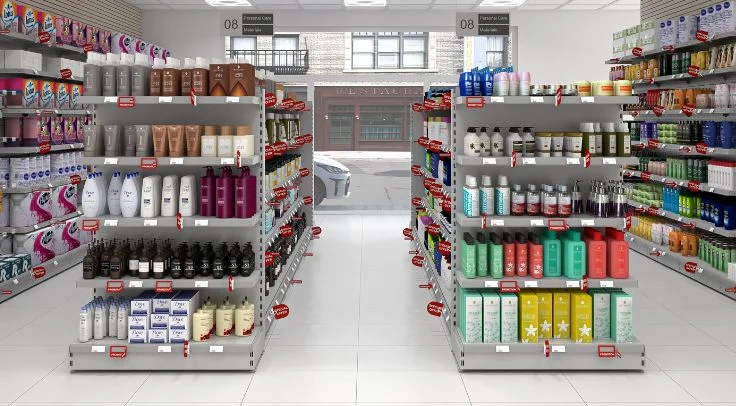
This is a practical retail shelving layout UK convenience stores use to guide customers, maximise product visibility, and drive sales. It covers how to layout shelving in a convenience store before a single unit is ordered, why the gondola shelving vs wall shelving UK debate misses the point, and the one mistake most retailers make that costs them every time they refit.
Most convenience store layout guides explain what gondola shelving and wall shelving are. This one explains how they work together because that is the question most store owners are actually trying to answer when they search for one or the other.
The short answer is that almost every successful convenience store in the UK uses both. The question is not gondola or wall shelving. It is how much of each, where, and in what configuration for the specific size and shape of your shop.
Here is how to work that out.
What gondola shelving and wall shelving are actually doing
They are not interchangeable products. They solve different problems in the same retail space.
Wall shelving units for shops run along the perimeter walls. Single-sided units present products on one face to customers walking along the wall. The perimeter is the most natural browsing route in any retail space – customers instinctively walk around the edges of a shop before they venture into the centre. Wall shelving captures that movement and fills it with product.
Gondola shelving for convenience stores creates the aisles in the centre of the shop. Double-sided freestanding units stand in the floor area between the walls, presenting products on both faces simultaneously. Gondolas define where customers walk, how long they walk, and what they see along the way. In a well-planned layout the gondola run is not just a shelving system, it is a customer journey.
The two systems work as a pair. Wall shelving captures the perimeter movement. Gondola shelving structures the centre floor movement. A shop with only wall shelving has no internal structure – customers browse the edges and leave without engaging with the full range. A shop with only gondola shelving has no visual anchor – the walls look bare and the shop feels unfinished.
How to layout shelving in a convenience store before ordering
The most common and expensive mistake in retail shelving is ordering before measuring. Here is the correct order of operations.
Draw the floor plan to scale:
It does not need to be architectural — a rough sketch with accurate measurements is enough. Mark the door position, any fixed fixtures (fridges, freezers, pillars), and the counter location. These are the anchors around which everything else is planned.
Identify the perimeter wall runs:
Measure the length of each wall available for shelving. Subtract any windows, doors, and fixed fixtures. The remaining length tells you how many wall shelving bays you need. Dynamic Shelf wall units are available in widths from 665mm to 1250mm, so the bay count depends on which width you choose and how many fit per run.
Plan the gondola runs:
The centre floor area between the perimeter runs accommodates the gondola layout. A single gondola run consists of a series of bays connected end to end, with a head unit or end bay at each end. Two or three gondola runs create two or three aisles — standard for a small to medium convenience store. The aisle width between runs needs to be at least 900mm for comfortable customer movement, and wider where trolleys or prams pass regularly.
Leave the checkout area clear:
The counter position defines the end of the customer journey. Gondola runs should funnel customers naturally towards the counter, not away from it. End bays at the checkout end of each gondola run are high-converting positions — customers approaching the till notice the end bay display before they queue.
What a small convenience store layout looks like in practice
A typical small UK convenience store, around 50 to 70 square metres, usually works with this configuration:
Wall shelving along three perimeter walls. The fourth wall is either the entrance or the counter wall. Two or three gondolas run in the centre floor, running parallel from the entrance wall towards the counter. Freezers and chillers along one or both side walls, with over-freezer gondola units maximising the display space above the chiller cabinets. A fruit and veg section near the entrance either a mobile stand positioned on the approach from the door or a small wall-shelving run dedicated to produce.
This layout creates a clear customer journey. Customers enter, see the produce section, walk along the first gondola aisle, browse the perimeter wall, loop back along the second aisle, and arrive naturally at the counter. The entire range is visible and accessible without a single dead end.
What a larger store layout looks like
Larger spaces (100 square metres and above) allow for more gondola runs, longer aisle lengths, and a more structured category layout.
The principle that separates a well-planned supermarket from a chaotic one is category adjacency. Products that are bought together should be displayed near each other. Bread near butter, pasta near sauces, tea near coffee near biscuits. When customers find related products together naturally, they stop planning their route and start browsing, which is the state in which impulse purchases happen.
Gondola shelving makes this possible because each run can be dedicated to a category. Wall shelving handles the high-volume lines that need consistent visibility: cleaning products, household goods, health and beauty, because the perimeter wall is always in view from anywhere in the shop.
End bays on each gondola run are the premium promotional positions. Rotating end bay stock every two to three weeks keeps the layout feeling fresh and gives more products promotional exposure over time.
Choosing the right shelving dimensions
Upright height: 1950mm and 2250mm are the two standard heights in the Dynamic Shelf range. For most UK convenience stores, 1950mm strikes the right balance between display capacity and visual openness. Taller 2250mm units maximise stock capacity and suit larger supermarket environments.
Bay width: 665mm, 800mm, 1000mm, and 1250mm are the standard widths. Most convenience stores use 1000mm or 1250mm bays as the primary run width. The Dynamic Shelf shop shelving systems UK retailers order most frequently combine 1000mm or 1250mm bay widths across both wall and gondola configurations for a consistent finish throughout the store.
Shelf depth: 300mm shelves suit smaller packaged products. 470mm shelves suit larger items and bulk products. Both depths use the same upright and bracket system, so they can be mixed within the same bay as the product range requires.
The mistake most retailers make when buying shelving
They buy wall shelving and gondola shelving from different suppliers.
It seems like a reasonable way to manage costs. In practice it creates a consistent operational headache. Heights do not match. Shelf depths differ. Colours clash slightly. The shop ends up looking like it was fitted out in stages over several years rather than as a considered retail environment.
Dynamic Shelf wall shelving and gondola shelving share the same upright height, shelf depth, and colour options across the full range. Ordering both from the same manufacturer means one delivery, one installation sequence, consistent dimensions throughout, and a shopfit that looks intentional from end to end.
Dynamic Shelf shelving for convenience stores and supermarkets
Dynamic Shelf supplies wall shelving units, gondola shelving units, over-freezer gondola units, shelves and accessories, and shop counters to UK convenience stores, supermarkets, and independent retailers directly from our Manchester warehouse. Factory-direct pricing. Consistent dimensions across the full range. In stock for 2–5 day delivery across the UK or same-day collection from our showroom at Unit 4 200 Waterloo Road, Manchester M88AE within 24 working hours.