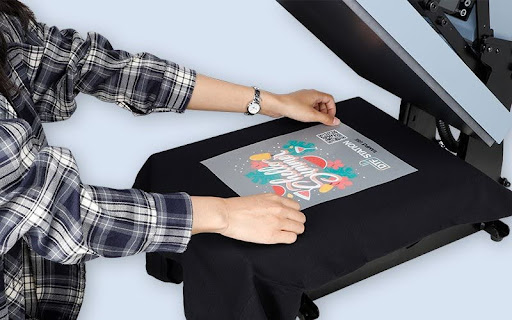
Direct-to-Film printing is applicable to a variety of fabrics and order quantities. DTF printers ensure consistency throughout the high-volume production.
Nevertheless, the process does not go without challenges. DTF printing has a number of quality problems not in the design itself but in tiny technical gaps during printing, curing, or heat pressing.
Ink clogging, poor adhesion, color variance, and peeling are common issues. The key to solving such problems is to understand the reasons they happen.
This article highlights the most common issues with DTF printing. The content below also offers practical solutions to maintain the quality of prints. It also minimizes the occurrence of downtimes and enhances the reliability of the entire production process.
Cracking After Washing.
- The over-curing or excessive heat during pressing mostly causes cracking.
- Repeated washing of fabric causes cracks in designs or prints.
- Fabric type plays a key role. Stretch fabrics should be fitted with the appropriate choice of adhesives and pressure.
Solution of Cracked Prints
- It is important to use a slightly lower curing temperature.
- Use uniform force on the heat pressing to ensure that the elasticity is maintained.
- A smaller powder adhesive is used on fine designs and stretchy fabric.
White Ink Clogging
- One of the most frequent problems of DTF printing is white ink clogging.
- More dramatic pigments are present in white ink. When circulation is not kept, these pigments settle rapidly.
- Clogging is typically manifested through loss of white layers. Gradually, it may occlude nozzles.
Solution of White Ink Clogging
This issue is greatly minimized by employing production-grade DTF printers.
- The solution begins with maintaining and designing printers.
- Incessant circulation of white ink is necessary.
- Nozzle inspections are necessary to detect problems.
- Long print runs require agitation to shake the ink tank.
Grey or Stale Colors.
- Problems with color vibrancy normally refer to problems with white ink density.
- DTF is a white ink-based product. In case it is too thin, the color gets lost, particularly on dark clothing.
- The other reason is the wrong RIP settings. With bad color profiling, bad output is generated even when the design file is good.
Solution
- There are solutions such as adjusting the white ink underbase levels and calibrated color profile.
- Color variation between batches is minimized using stable printing platforms.
- Ink quality also matters. DTF inks are designed in such a way that they adhere to powder and fabric appropriately.
Poor Adhesion after Heat Pressing
- The design is sometimes fine on pressing, but begins to peel after washing. This is generally a sign of failure to adhere.
- Incorrect heat-press settings, and when adhesive powder is under-cured, it spoils the design. Bonding may also be weakened by moisture in cloth.
Solution of Poor Adhesion
- To correct this, the curing temperature and time should be calibrated.
- Pre-pressing the clothes will eliminate moisture and enhance the transfer characteristics.
- The durability and surface smoothness are enhanced by applying a protective sheet in the second press.
Ink Smudging/ Blurring.
- Smudging is normally caused by the late application of adhesive powder or when the printed film is shaken before the ink settles.
- Ink may also take a long time to dry in high humidity.
- Surface stability is also impacted by airflow problems.
Solution
- The solution is instant powder application and controlled environmental conditions.
- Do not touch the printed parts. Have a clean and dust-free workspace.
- Constant environmental control enhances print glow.
Rough or Thick Texture of Printing.
- The fabric’s roughness is due to excessive use of adhesive powder. The issue arises in manual powder application systems.
- The powder not scraped off prior to being cured forms a thick, uncomfortable print layer.
Solution
- It is solved by controlling powder application.
- Adequate shaking is necessary to remove surplus material.
- Powder systems that are automated are more consistent.
- Experience and attention to detail should be involved when the application is done manually.
- Detailed graphics made with fine powder enhance a smooth touch.
Diffusion in Results between Batches.
- One of the largest problems of scaled production is inconsistent output.
- It is usually a result of slight setting variations, material fluctuation, or maintenance lapses.
Solution
- This problem is resolved with the help of standard operating procedures.
- Printing, curing, and pressing are documented settings that produce repeatable results.
- Unexpected quality declines are avoided through regular maintenance schedules.
Numerous production settings are based on integrated systems that are procured on a platform like dtflinko.com to ensure consistency in printing workflow.
Conclusion
When issues are detected at the initial stages, they are solved appropriately. DTF printing will continue to be a reliable option when it comes to creating quality, customized clothes in large quantities.
Frequent testing, rigorous maintenance, and stable equipment are the baseline of predictable output. It should be known how the behavior of ink, curing, choice of film, and heat application interact to minimize mistakes.