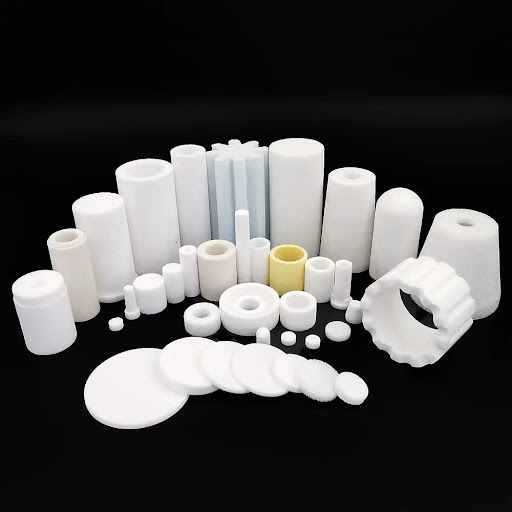
Sintered porous plastic filters are common in many industries. They clean fluids and gases by letting them pass through tiny holes while catching unwanted particles. In this article, we explain what these filters are, how they get made, how they actually work, their good and bad points, and where people use them. This should help you understand why they are a solid choice for many filtration jobs.
What Is a Sintered Porous Plastic Filter?
A sintered porous plastic filter is a piece made from plastic powder that has been heated and pressed under special conditions. The plastic is usually polyethylene (PE), polypropylene (PP), or PTFE. These materials get turned into a solid part with lots of small, connected holes. The holes let air, water, or other fluids pass through, but they keep dirt, dust, and other particles from passing through.
The key thing is the sintering process. It bonds the plastic particles together without fully melting them. This creates a strong structure that holds its shape even under pressure. The filter ends up with even pore sizes that you can control during making. Pore sizes often range from less than 1 micron up to 200 microns or so, depending on what you need.
These filters are different from regular mesh or paper filters because they have no added glue or binders. Everything comes from the plastic itself, so there’s less chance of extra stuff getting into your system.
How Are Sintered Porous Plastic Filters Made?
The making process starts with fine plastic powder. Workers put the powder into a mold to give it the desired shape, such as a disc, tube, or sheet.
Next comes compaction. They press the powder with force to pack the particles close together. This step helps set the final density and pore size.
Then the real sintering happens. The pressed powder is placed in an oven at a temperature just below the plastic’s melting point. Heat makes the particles stick at their contact points through a process called diffusion. The particles bond without turning into a liquid, so the spaces between them remain open pores.
After heating, the part cools down slowly. This keeps the structure stable. Sometimes they do extra steps like trimming or adding supports. The result is a tough, porous filter that can handle flow and pressure well.
You can adjust factors such as temperature, time, and pressure to change pore size, porosity (typically 30% to 85%), and strength. This lets makers create filters for specific jobs.
How Does the Filter Work?
The main job is to clean fluids or gases as they move through. Here’s how it happens step by step.
First, the dirty fluid or gas enters one side of the filter. Pressure pushes it toward the other side.
As it moves into the porous structure, particles larger than the pore size get trapped immediately. They can’t fit through the small holes, so they stay trapped on the surface or inside the channels. This is called sieving or mechanical trapping, and it’s the main way big particles get removed.
Smaller particles can go deeper. Some get caught by sticking to the plastic walls through adsorption. Others slow down due to diffusion, bumping into walls in the tiny paths. Electrostatic forces can also pull charged particles to the surface.
The connected pores create a long, winding path. This increases the chance that particles hit the walls and stay behind. Clean fluid or gas flows out the other side with far fewer contaminants.
The filter works in both directions in some cases, but most setups have a flow direction marked to keep trapped stuff on the dirty side.
Over time, the filter can load up with particles. This raises pressure drop across it. When pressure gets too high, you clean or replace it. Many of these filters clean well with backwashing, solvents, or ultrasound, so they last a long time.
Advantages of Sintered Porous Plastic Filters
These filters have several strong points that make them popular.
They resist many chemicals well. Plastics like PE and PTFE don’t break down in acids, bases, or solvents. This makes them good for harsh liquids.
They are lighter than metal filters. This helps in systems where weight matters, such as portable devices or medical equipment.
Cost is often lower than metal or ceramic options, especially for medium volumes.
They give consistent filtration because the pores are uniform. You get reliable performance over time.
No media migration happens. Since there are no loose fibers or binders, nothing sheds into the clean side.
They are easy to shape into complex forms, such as custom sizes or those with built-in features.
Many can handle sterilization for clean use, such as in labs or pharma.
Disadvantages of Sintered Porous Plastic Filters
They do have some limits.
Heat resistance is low. Most handle up to about 150°C, sometimes less. Above that, the plastic can soften or melt.
Mechanical strength is lower than that of metal filters. They might not take very high pressure without deforming.
In very dirty flows, they can clog faster than some other types, needing more frequent cleaning.
They are not ideal for very high temperatures or super-aggressive chemicals that attack plastics.
Common Applications
Sintered porous plastic filters show up in many places.
In medical devices, they filter air or liquids in inhalers, nebulizers, and IV lines. They help deliver exact doses and keep things sterile.
In water treatment, they remove particles from drinking water or process water.
Chemical processing uses them to filter aggressive fluids without corrosion issues.
In venting, they let air in or out of tanks while stopping dust or spills. Some self-seal when wet to prevent leaks.
Automotive and industrial air filters use them to clean intake air or vent gases.
Food and beverage industries like them for safe contact with drinks or ingredients.
Labs and pharma rely on them for precise filtration in experiments or drug making.
Final Thoughts
Sintered porous plastic filters work by using a network of tiny, connected pores to trap particles while letting fluids pass. The sintering process creates a durable, uniform structure from plastic powder without full melting. This gives good chemical resistance, consistent performance, and reusability at a reasonable cost.
They suit many jobs where heat isn’t extreme and chemical compatibility matters. If you need one, a sintered plastic filter manufacturer can help with custom options.
For more on filtration solutions, visit NESIA Filter. They offer details on different types and uses.
Understanding how these filters work helps you pick the right one for your setup. They provide clean, reliable results in everyday and tough applications alike.