Travellers booking tickets to India often compare long-distance rail with domestic flights, and India’s intercity train network remains one of the most structured transport systems in the region. Trains operate across thousands of kilometres, connecting major metros with tier-2 and tier-3 cities through predictable schedules, defined carriage layouts and a highly systemised booking process. Understanding how train categories, booking mechanics, platform routines and onboard operations actually work helps UK visitors navigate the system efficiently.
Major Train Categories
India operates multiple service tiers, each designed for specific speeds, comfort levels and journey lengths.
Rajdhani Express
Rajdhani trains are premium long-distance services linking New Delhi with major cities such as Mumbai, Kolkata, Chennai, Bengaluru and Guwahati. They are fully air-conditioned, prioritised by signalling systems, and generally run faster than other long-distance trains. Fares include onboard meals, and seating is available in AC Chair Car, AC 2-tier and AC 3-tier sleepers.
Shatabdi Express
Shatabdi trains are daytime intercity services connecting major regional hubs. They operate at relatively high speeds and offer only seated accommodation—typically Executive Chair Car and AC Chair Car. Meals are included, and trains are designed for same-day return travel rather than overnight journeys.
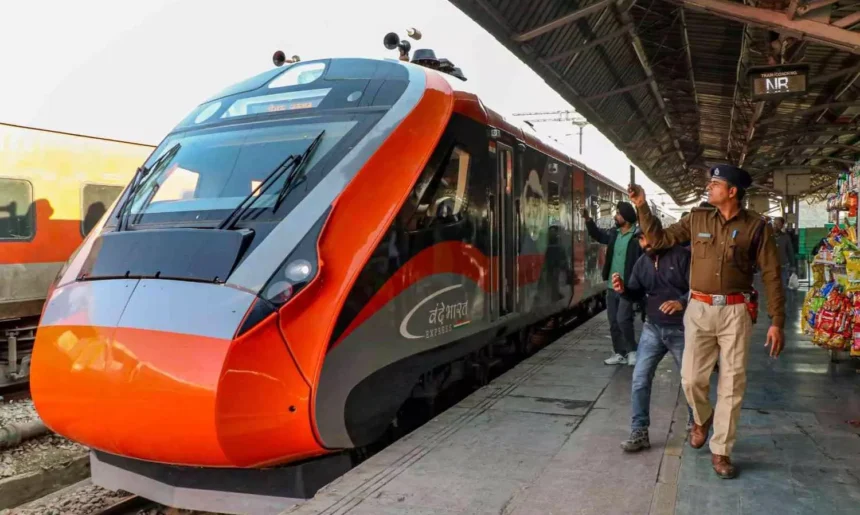
Vande Bharat Express
This is India’s semi-high-speed, modern train category. Vande Bharat trains offer air-conditioned seating only, with contemporary interiors, automated doors, improved suspension and faster acceleration. They serve routes such as Delhi–Varanasi, Mumbai–Ahmedabad and Chennai–Mysuru. Catering is optional and packaged to maintain cleanliness standards.
Sleeper Classes (Conventional Long-Distance Trains)
India’s core long-distance network consists of conventional trains with multiple class options:
- Sleeper Class (Non-AC): Open berths with minimal insulation; the most widely used class.
- AC 3-Tier: Air-conditioned, open-berth format with three tiers of beds.
- AC 2-Tier: Fewer berths per bay and more privacy.
- AC 1-Tier: Enclosed cabins with lockable doors.
These trains run through day and night across the country and form the backbone of India’s long-haul mobility.
Booking Process on IRCTC and Third-Party Platforms
Long-distance tickets are primarily booked through the IRCTC (Indian Railway Catering and Tourism Corporation) system. Understanding availability categories is essential.
Booking Through IRCTC
Travellers create an IRCTC account, search trains by origin/destination and select class and date. The system displays availability as:
- Available (AVL): Confirmed seats or berths.
- RAC (Reservation Against Cancellation): Travellers receive a seat but may share a berth until upgrades occur.
- WL (Waitlist): No seat initially assigned; confirmation depends on cancellations.
Payment is made through cards, net banking or authorised third-party wallets. E-tickets are issued instantly.
Third-Party Sites
Platforms like Cleartrip, MakeMyTrip and Paytm integrate with IRCTC. They simplify payment for foreign cards but still rely on IRCTC’s confirmation structure. Travellers receive digital tickets with coach/berth details once confirmed.
WL and RAC Behaviour
- RAC: You can board the train. You receive a guaranteed seat and may later be upgraded to a full berth if cancellations occur.
- WL: You cannot board if WL status remains after chart preparation. Charting happens 2–4 hours before departure.
These rules are strictly enforced.
Platform Movement and Boarding Procedures
Indian stations can be large, multi-platform environments. A procedural approach prevents confusion.
Platform Identification
- Digital boards list train numbers, coach positions and departure times.
- Announcements are frequent and usually in English as well as Hindi.
- Coach position boards along the platform help passengers move to the correct area before the train arrives.
Boarding
Long-distance trains stop briefly, so passengers typically wait near their coach position number. Porters (coolies) are available for hire and can navigate crowded platforms efficiently.
Carriage Layouts and Movement Inside the Train
Rajdhani/Shatabdi/Vande Bharat
- Seat numbers follow a fixed pattern printed on the reservation chart.
- Luggage racks are above seats; larger bags stay near the entrance vestibule.
- Wide aisles allow controlled movement for catering staff and security checks.
Sleeper Trains
- Berths are arranged in open bays (2-tier or 3-tier).
- Side berths run along the corridor.
- Bedding is provided in AC classes but not in Sleeper Class.
Catering Schedules and Onboard Routines
Catering follows predictable patterns:
- Rajdhani/Shatabdi: Meals included and served on a set schedule. Tea, snacks, lunch/dinner and water are provided.
- Vande Bharat: Optional catering; meals are pre-packaged.
- Sleeper Trains: Vendors onboard sell tea, snacks and simple meals. Hygiene varies, so many passengers carry their own supplies.
Security staff patrol most long-distance trains, and ticket inspectors check reservations shortly after departure.
Charging Points, Wi-Fi and Electrical Stability
Charging sockets are available in all AC coaches and most sleeper classes. Voltage can fluctuate, so devices may charge slowly during peak usage. Wi-Fi is limited mainly to Rajdhani and Shatabdi, and even then speeds are modest.
Overnight Etiquette and Washroom Rotation
Overnight Etiquette
- Lights dim after 10 pm in sleeper coaches.
- Passengers keep noise low; families with children settle early.
- Side berths remain communal spaces, so movement continues along the corridor.
- Curtains or partitions in AC classes provide limited privacy.
Washroom Rotation
Carriages have two washrooms per end—one Western-style and one squat-style. Cleanliness varies but is managed better in AC categories. Passengers usually coordinate usage during mornings and evenings when demand spikes.
Final Thoughts
For travellers booking tickets to India, the intercity train system is structured, rule-driven and designed to handle massive volumes efficiently. Understanding booking mechanics, platform processes, carriage layouts, seating norms, overnight routines and onboard services makes long-distance rail travel more predictable. With clear expectations and attention to procedure, UK travellers can navigate India’s rail infrastructure with confidence and minimal complexity.